Los Angeles tap water comes out of the tap with calcium hardness levels that regularly exceed 400 ppm. Most pool owners don't realize the damage that's already accumulating until the tile line turns white, the heater loses efficiency, or the filter starts short-cycling. Here's what actually goes wrong, and what to do instead.
Serving Los Angeles, Orange County & Inland Empire
Learn more about pool tile cleaning calcium removal Los Angeles →
Learn more about LA hard water pool treatment in Inland Empire →
Learn more about heat pump pool heater repair Los Angeles in Orange County →
15+ Crew Members ● In Business Since 2020
The Hard Water Problem in LA
LA's municipal water supply draws from the Colorado River and Sierra Nevada snowpack, both naturally high in dissolved calcium and magnesium. By the time water reaches your pool, it's already primed to deposit scale on every surface it touches, especially once it warms up.
Calcium carbonate doesn't care what your pool looks like. It builds up on tile grout, inside heater heat exchangers, on salt cell plates, and along the waterline every single week. A pool that runs at a calcium hardness of 600 ppm and a pH of 7.8 will start depositing visible scale within a few months. That's not a rare edge case. That's a typical Los Angeles pool by summer.
The Langelier Saturation Index (LSI) is the standard the industry uses to measure whether water is corrosive, neutral, or scale-forming. You can read more about LSI and water chemistry standards at the U.S. Environmental Protection Agency and the Association of Pool and Spa Professionals (APSP). In LA, getting the LSI to a neutral range (between -0.3 and +0.3) takes active management, not just occasional chlorine tabs.
Our full Los Angeles Hard Water Pool Guide covers the chemistry in depth. Here, we'll focus on the specific mistakes we see most often, and what the right approach actually looks like.
We test calcium hardness, total alkalinity, pH, cyanuric acid, and LSI on every visit. Call us or request a quote and we'll tell you exactly where your water stands.
View Chemical Balancing Services →The Mistakes That Cost the Most
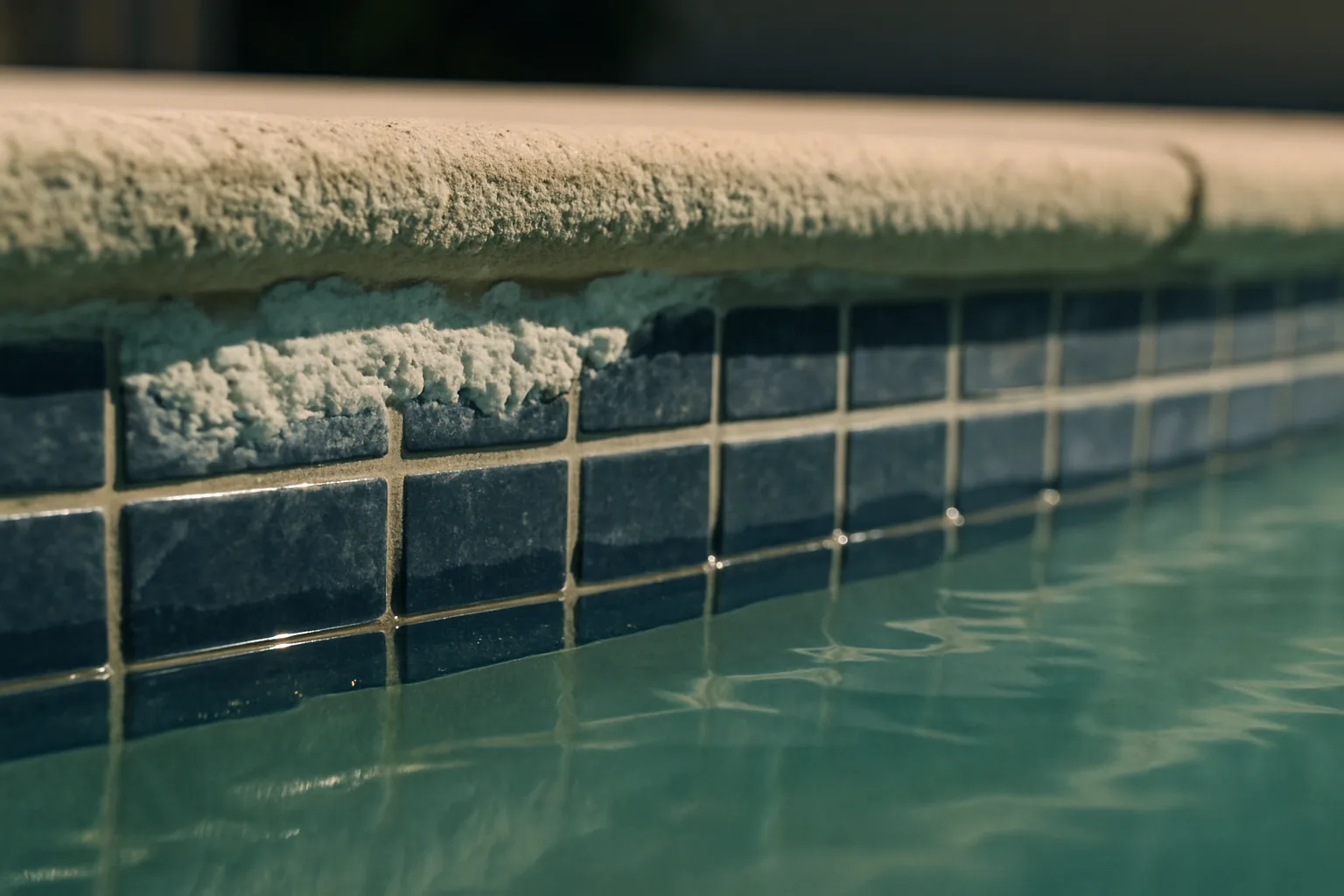
By the time the tile line turns white, the damage is already weeks or months old. Calcium scale doesn't form overnight, but it's invisible until it has already bonded to the surface. At that point, you're looking at tile cleaning, acid washing, or, in bad cases, replastering.
Test calcium hardness monthly. The recommended range is 200 to 400 ppm. LA tap water frequently starts at 350 to 450 ppm before evaporation concentrates it further. Once you're above 500 ppm, partial drains or dilution treatments are often the fastest fix. Our pool tile cleaning service handles the aftermath, but prevention is far cheaper.
pH above 7.8 accelerates scale formation significantly. CO2 off-gasses faster in warm weather, which drives pH up. Aeration from waterfalls and jets does the same thing. In LA's summer heat, unchecked pH can climb from 7.4 to 8.0 in a week. Muriatic acid additions need to be regular and calculated, not occasional.
Balancing pH and alkalinity separately isn't enough. The LSI accounts for temperature, calcium hardness, total dissolved solids, and cyanuric acid together. A pool with "good" pH and alkalinity readings can still be significantly scale-forming if calcium hardness is 600 ppm and water temperature is 85°F. Use the full index, every time. The Pool and Hot Tub Alliance publishes guidance on proper water balance standards.
Topping off a pool with local tap water adds calcium every time. This is one of the most common mistakes we see. Evaporation concentrates existing minerals. When you refill with more high-hardness municipal water, you're not diluting the problem, you're adding to it.
When a partial drain and refill is necessary, some pool owners in LA use a reverse osmosis (RO) truck service that can recycle the existing water and lower calcium hardness to around 50 to 100 ppm without draining. It costs more upfront than a standard partial drain but uses significantly less water, which matters in a drought-prone region.
The heat exchanger is the most expensive casualty of hard water. Calcium deposits inside a copper or cupro-nickel heat exchanger are almost impossible to remove chemically once they've hardened. At that point, replacement is the only option. Annual descaling treatments and proper LSI management are the only real prevention. See our pool heater repair service for what comes after scale damage takes hold.
Saltwater pools are not maintenance-free in LA. They generate chlorine through electrolysis, and calcium deposits on the salt cell blades interrupt that process. A cell running at 100% output because it's trying to overcome scale is a cell that's failing. We inspect salt cell condition as part of our regular service on saltwater conversions. Learn more about the saltwater conversion process.
An acid wash or partial drain gets your calcium back into range, but it doesn't stop the water from hardening again. LA pools need ongoing, monthly calcium hardness testing and consistent pH management. Without a maintenance schedule, you're back to the same problem in 6 to 12 months.
Our weekly pool maintenance service includes water testing at every visit, not just when something looks wrong. Catching a rising LSI early means adjusting chemistry, not scheduling a drain. See the full comparison of pool service vs. DIY in Los Angeles to understand what consistent management actually costs versus the alternative.
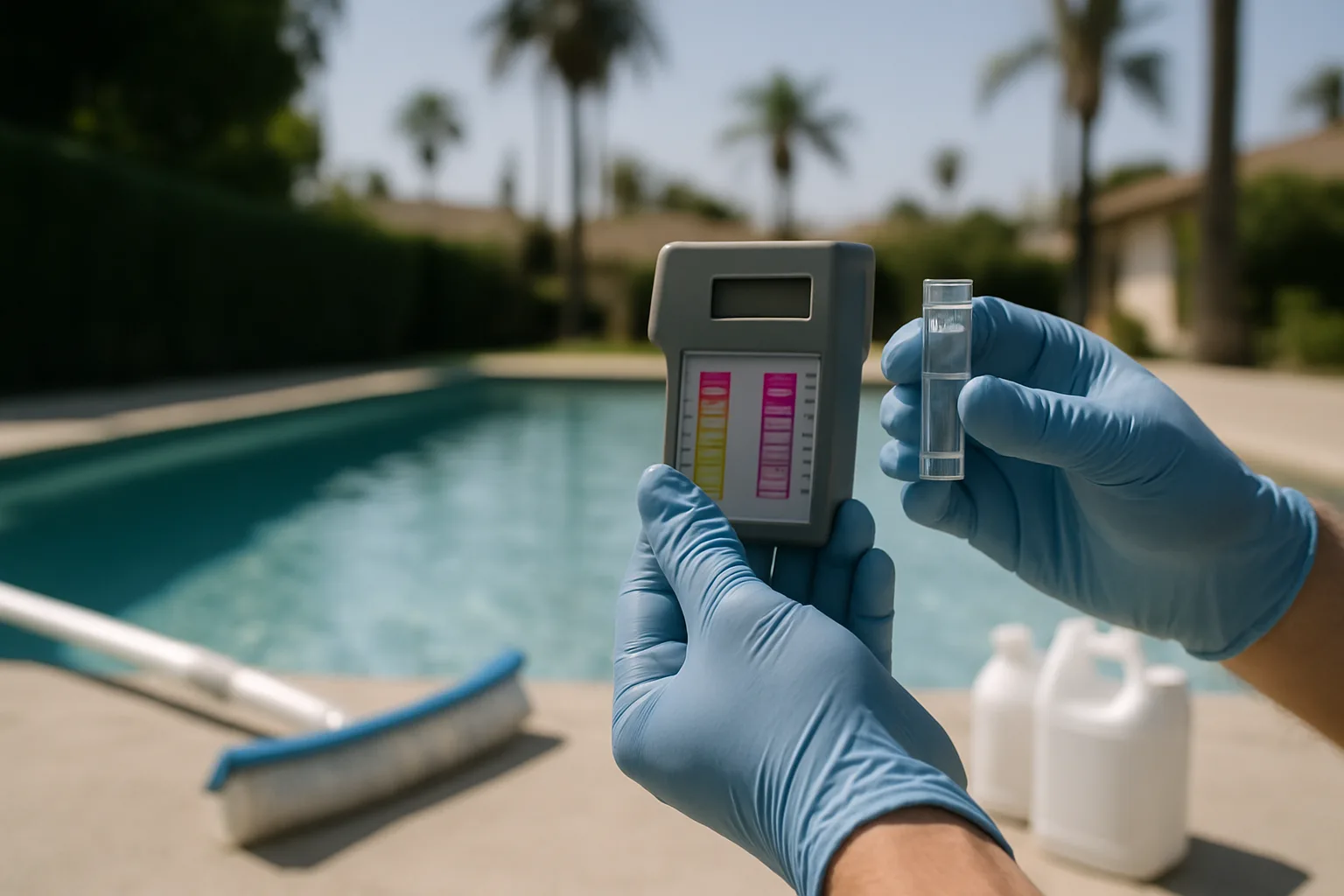
Test strips don't measure calcium hardness accurately. They're fine for a quick chlorine check, but for hard water management you need a proper drop-test or digital kit that measures calcium hardness, total alkalinity, stabilizer, and pH with precision. A strip telling you "pH is in range" while calcium is at 700 ppm means nothing. A thorough professional chemical balancing service includes the full panel.
How We Handle It
Hard water treatment isn't a product you add once. It's a combination of regular testing, chemistry adjustments, physical cleaning, and equipment checks that happen on a consistent schedule.
On a weekly maintenance visit, our crew checks pH, free chlorine, combined chlorine, and total alkalinity. Calcium hardness and cyanuric acid are tested monthly. If calcium is trending above 500 ppm, we flag it immediately and discuss options: partial drain, RO treatment, or increasing acid dosing frequency to keep the LSI in range.
Tile line scale gets physically removed before it bonds too deeply. Once calcium carbonate has calcified for more than 6 months, the only effective removal is bead blasting or professional acid washing. Early cleaning, done quarterly in most LA pools, avoids that. Our dedicated pool tile cleaning service handles both routine scale removal and severe buildup.
Filter performance is directly tied to hard water management. A pool with high calcium sheds more particulate, which clogs cartridge and DE filters faster. Our pool filter service adjusts cleaning frequency based on actual water conditions, not a generic schedule.
Scale inside a heater heat exchanger causes premature failure. Scale on a salt cell shortens cell life by years. Scale inside plumbing increases pump load. Variable-speed pump upgrades help extend equipment life, but only if water chemistry is also managed.
Pool Equipment Repair →Hard water in a spa is a faster problem than in a pool. Water temperatures of 98 to 104°F accelerate calcium deposition dramatically. Spas also use less water volume, meaning chemical changes happen quickly. Scale on spa jets and heaters is one of the most common service calls we get.
Spa and Hot Tub Service →Commercial pools in LA face the same hard water chemistry but at higher bather loads and with more regulatory oversight. Scale that degrades a residential heater over 3 years can damage commercial equipment in 18 months. We service commercial accounts throughout Los Angeles, Orange County, and the Inland Empire.
Commercial Pool Service →Monthly at minimum. If you're actively managing a high-calcium situation or have recently done a partial drain, test weekly until levels stabilize. Calcium hardness doesn't change as fast as pH or chlorine, but it moves in one direction in LA: up. Catching it at 450 ppm is manageable. Catching it at 700 ppm means a drain.
The only practical options are dilution or RO treatment. Dilution means replacing a portion of pool water, which works but adds more LA tap water and creates a short-term improvement that degrades quickly. RO treatment recycles the existing water through a membrane and can bring calcium from 600 ppm down to under 100 ppm in one session. It's more expensive but uses far less water and holds longer.
No. Home water softeners use ion exchange to replace calcium and magnesium with sodium. Adding softened water to a pool raises sodium levels, which interferes with salt cell operation in saltwater pools and throws off total dissolved solids. Most pool professionals advise against filling pools with softened water. The better approach is managing the chemistry of what's already in the pool.
Salt cells generate chlorine through electrolysis, and calcium plates directly onto the cell blades during that process. This is normal, which is why salt cells need periodic acid washing to clear calcium buildup. In LA conditions, this happens faster than manufacturers assume. A cell that might need cleaning twice a year in low-hardness areas may need it four to six times in LA. Running a scaled cell at full output accelerates failure. Our saltwater pool service includes cell inspection every visit.
High calcium hardness by itself doesn't turn a pool green. But scale buildup inside filter media reduces filtration efficiency, which allows algae to take hold faster when chlorine dips. A pool with scaled filters, poor circulation, and a chemistry swing after heavy rain or bather load is more likely to go green quickly. See our guide on why pools go green after rain in LA for more on that sequence.
Yes. Ash deposits change pool chemistry rapidly, raising pH and introducing phosphates and other compounds. Combined with already high calcium, ash events create a fast-moving chemistry problem that most homeowners underestimate. We've seen pools shift dramatically in chemistry within 24 hours of a major ash event. Our wildfire and Santa Ana pool recovery guide covers the full recovery process.

Blue Line Pool
We serve Los Angeles, Orange County, and the Inland Empire with a crew of 15 or more technicians. Every account has a single point of contact. If something's wrong with your pool chemistry, equipment, or water quality, you get one call and one answer.
Hard water management is part of every service we offer, from weekly maintenance to equipment repair to post-wildfire cleanup. We've been running pools in LA since 2020 and we know what this water does to equipment over time.
Free quotes, no pressure. Call 805-870-5019 or use the contact page below. You can also read more in our full hard water resource guide or browse our complete service list.
15+
Crew Members
3
Service Regions
1
Point of Contact
✓
Free Quotes
Pages from our resource library that go deeper on LA pool chemistry and service.
We operate across three regions with year-round availability.